

Canned sweet corn has become one of the most widely consumed vegetable products in the global processed food industry. With its naturally sweet taste, stable shelf life, and versatile applications, it plays a crucial role in both retail consumption and food service supply chains. For importers, distributors, and private label brands, canned sweet corn is not just a convenience food—it is a strategic, high-turnover staple product that supports year-round supply stability.
Much like how modern apartment developers in Southeast Asia increasingly prefer fingerprint smart locks with temporary password functions for efficient visitor management, global food buyers are also shifting toward shelf-stable, ready-to-use ingredients like canned sweet corn. The logic behind both decisions is the same: efficiency, reliability, and reduced operational complexity.
This article provides a comprehensive breakdown of canned sweet corn, including its production process, nutritional value, market applications, packaging formats, and global trade trends.
What Is Canned Sweet Corn?
Canned sweet corn is a preserved vegetable product made from freshly harvested sweet corn kernels that are processed, sealed in cans with brine or water, and sterilized at high temperature to ensure long shelf life.
The raw material is sweet corn (Zea mays saccharata), harvested at its tender “milk stage” when natural sugars are at their peak. This is what gives canned corn its signature sweetness and soft texture.
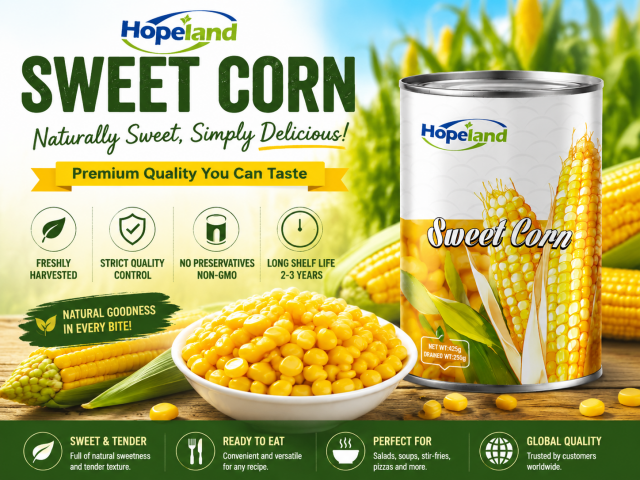
Unlike field corn used for starch or animal feed, sweet corn is specifically cultivated for human consumption due to its higher sugar content and delicate kernels.
Key characteristics:
· Naturally sweet flavor
· Ready-to-eat convenience
· Shelf life of 2–3 years
· No refrigeration required
· Wide culinary applications
How Is Canned Sweet Corn Produced in Industrial Factories?
The production of canned sweet corn follows strict food safety and quality control standards to ensure consistency and export compliance.
Step 1: Raw Material Selection
Fresh corn is harvested and transported quickly to processing facilities. Only tender, high-sugar corn is selected.
Step 2: Husking and Cleaning
Corn husks and silk are removed, followed by thorough washing.
Step 3: Kernel Cutting
Mechanical cutting machines separate kernels from the cob while preserving integrity.
Step 4: Blanching
Brief heat treatment stabilizes color, texture, and enzyme activity.
Step 5: Filling into Cans
Corn kernels are filled into sterilized cans with water or light brine.
Step 6: Sealing
Cans are vacuum-sealed to prevent contamination.
Step 7: Sterilization
High-temperature sterilization ensures long shelf life and food safety.
Step 8: Cooling and Storage
Finished products are cooled, labeled, and stored for shipment.
What Is the Nutritional Value of Canned Sweet Corn?
Canned sweet corn retains most of the nutritional benefits of fresh corn and remains a healthy carbohydrate source.
Typical nutrition per 100g:
· Calories: 100–130 kcal
· Carbohydrates: 20–30g
· Protein: 3–5g
· Fiber: 2–4g
· Fat: low
· Vitamins: B1, B3, B6
· Minerals: potassium, magnesium
Health benefits:
Supports digestive health
Dietary fiber promotes healthy bowel movement.
Provides stable energy
Natural carbohydrates offer long-lasting energy.
Contains antioxidants
Lutein and zeaxanthin support eye health.
Suitable for balanced diets
Low fat and moderate calories make it widely diet-compatible.
Why Is Canned Sweet Corn So Popular in Global Markets?
Global demand for canned sweet corn continues to grow due to lifestyle and supply chain changes.
1. Convenience-driven consumption
Modern consumers prefer ready-to-use ingredients that reduce cooking time.
2. Year-round availability
Unlike fresh corn, canned corn is not affected by seasonality.
3. Food service demand
Restaurants use canned corn in soups, salads, pizzas, and mixed dishes.
4. Retail expansion
Supermarkets increasingly promote canned vegetables as pantry staples.
What Packaging Options Are Available for Canned Sweet Corn?
Different markets require different can sizes and labeling formats.
Common sizes:
· 198g / 200g (single serve)
· 300g / 340g (retail standard)
· 400g / 425g (export standard)
· 2.5kg / 3kg (food service use)
Product variations:
· Sweet corn in brine
· No-salt-added corn
· Cream-style corn
· Vacuum-packed corn
OEM options:
· Private label branding
· Multi-language packaging
· Nutrition label customization
Where Is Canned Sweet Corn Used in the Food Industry?
Canned sweet corn is one of the most versatile ingredients in global cuisine.
Household use:
· Fried rice
· Soups
· Stir-fry dishes
· Salads
Food service:
· Buffets
· Fast food chains
· Catering services
Food manufacturing:
· Frozen meals
· Ready-to-eat products
· Snack fillings
International cuisines:
· Mexican dishes
· American casseroles
· Asian fusion meals
· Mediterranean salads
What Quality Standards Are Required for Export Canned Sweet Corn?
Export-grade canned sweet corn must meet strict international food safety standards.
Certifications:
· HACCP
· ISO 9001
· BRC
· HALAL (for specific markets)
Quality control focuses on:
· Kernel uniformity
· Color consistency
· Texture stability
· Low defect rate
· Balanced brine formulation
What Are the Global Market Trends for Canned Sweet Corn?
The canned sweet corn market is growing steadily due to structural food consumption changes.
Key trends:
1. Rising demand in emerging markets
Asia, Africa, and South America show strong import growth.
2. Expansion of private label brands
Supermarkets increasingly rely on OEM canned vegetables.
3. Health-oriented product upgrades
Low-sodium and clean-label products are gaining traction.
4. Sustainability advantages
Canned foods reduce food waste and cold-chain dependency.
What Should Importers Consider When Buying Canned Sweet Corn?
For B2B buyers, supplier selection directly affects product competitiveness.
Key considerations:
· Raw material freshness
· Factory certifications
· Export experience
· Production capacity
· Packaging flexibility
· Price stability
A strong supplier should also support OEM customization and stable long-term supply.
Conclusion: Why Canned Sweet Corn Remains a Strategic Global Commodity
Canned sweet corn is more than a simple vegetable product—it is a globally strategic food ingredient that supports modern food systems.
Its success is driven by:
· Natural sweetness and consumer acceptance
· Advanced processing technology
· Long shelf life and stability
· Wide industrial applications
As global demand for convenient, shelf-stable foods continues to rise, canned sweet corn will remain a core category in international canned food trade.
For importers and distributors, working with a reliable manufacturer ensures consistent quality, stable supply, and stronger market competitiveness in an increasingly dynamic global food industry.