

Production
As global demand for high-quality canned fruit continues to grow, international buyers are placing greater emphasis on visiting manufacturing facilities before establishing long-term partnerships. Factory audits allow importers to verify food safety systems, production capabilities, quality control procedures, and supply chain reliability firsthand.
Recently, AMOYTOP Foods had the pleasure of welcoming an important customer from Peru to visit our fruit processing factory in Dangshan, Anhui Province—one of China's most famous fruit-producing regions. During the visit, our customer inspected every stage of production, from raw material selection to finished product loading, gaining a comprehensive understanding of how premium canned yellow peach and canned fruit cocktail are produced.
The visit was not only an opportunity to strengthen our business relationship but also a valuable exchange of ideas regarding market trends, product development, and future cooperation in the South American market.
Why Dangshan Is the Ideal Location for Premium Canned Fruit
When discussing canned fruit production in China, Dangshan is a name that cannot be overlooked.
Known as the "Fruit Capital of China," Dangshan enjoys favorable climatic conditions, fertile soil, and abundant sunshine, making it one of the country's most important fruit-growing regions.
For decades, local growers have specialized in cultivating high-quality peaches, pears, apples, and other fruits used in export-grade canned products.
The proximity between orchards and processing facilities offers several advantages:
· Fresher fruit delivered within hours after harvesting
· Reduced transportation damage
· Better flavor retention
· Higher nutritional value
· Consistent raw material quality
These advantages are particularly important for producing premium canned yellow peach products that meet international quality standards.
A Warm Welcome to Our Customer from Peru
Upon arrival, our Peruvian customer was welcomed by our sales and technical teams before beginning a comprehensive factory tour.
The visit included:
· Company introduction
· Production workshop inspection
· Quality laboratory visit
· Packaging line observation
· Warehouse tour
· Loading process demonstration
· Product tasting session
· Technical discussion
· Business meeting
Throughout the visit, both teams exchanged valuable insights regarding product specifications, packaging preferences, and the growing demand for canned fruit in South America.
From Orchard to Can: Understanding Our Production Process
One of the highlights of the visit was seeing how fresh fruit is transformed into export-quality canned products.
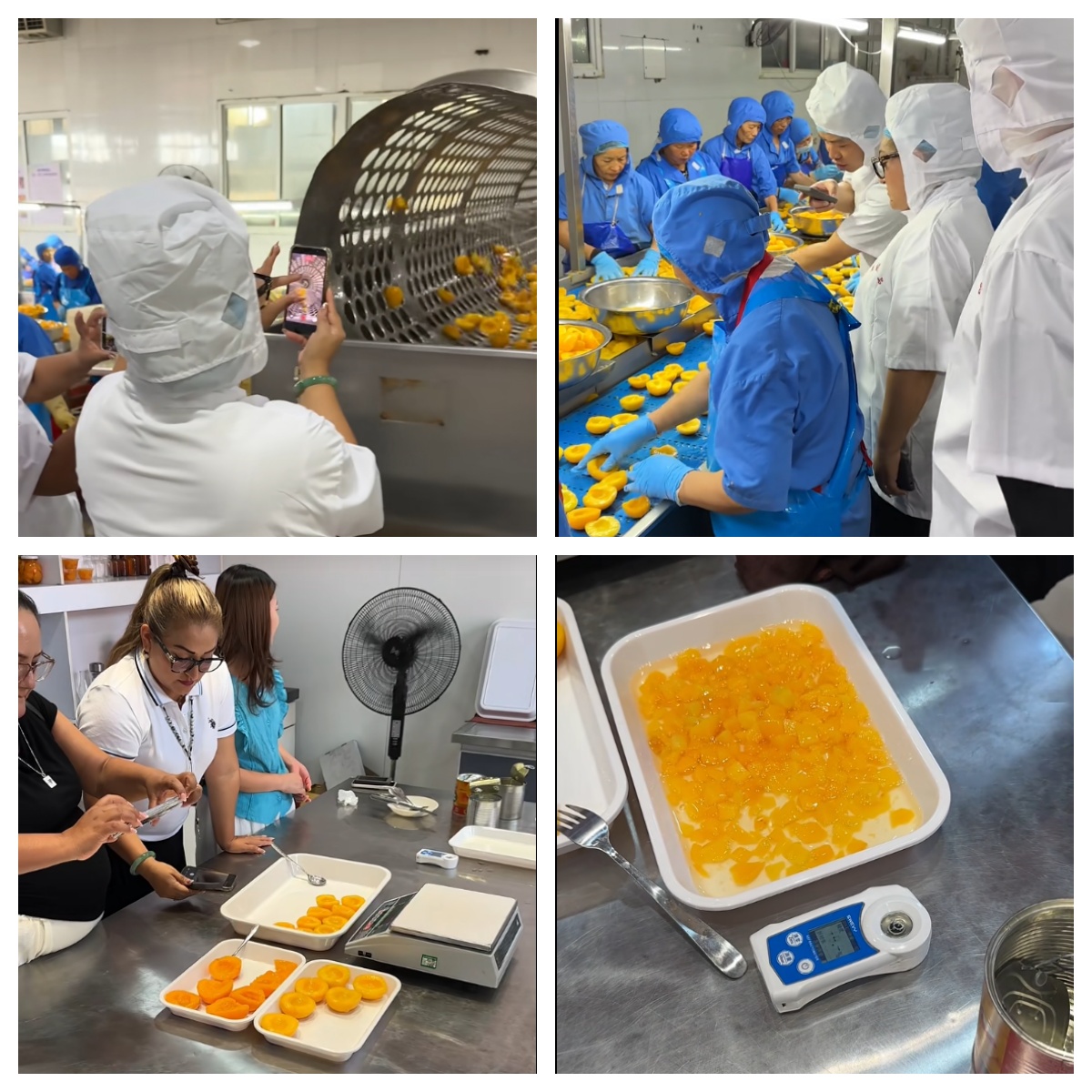
Step 1: Careful Fruit Selection
Only ripe, healthy fruit meeting export standards is selected.
Each batch undergoes strict inspection for:
· Appearance
· Size
· Ripeness
· Sugar content
· Texture
· Absence of defects
Any fruit failing to meet our standards is removed before production begins.
This strict selection process ensures every can maintains consistent quality.
Step 2: Washing and Sorting
The fruit passes through multiple washing systems to remove dust and impurities.
Automatic sorting equipment separates fruit by size and quality to ensure uniformity in each production batch.
Our customer was impressed by the automation level and hygiene standards throughout this stage.
Step 3: Peeling and Cutting
Depending on customer requirements, peaches are processed into:
· Halves
· Slices
· Dices
Every cutting operation is carefully controlled to maintain an attractive appearance and consistent dimensions.
This consistency is particularly important for supermarket private labels and foodservice customers.
Step 4: Filling and Syrup Preparation
The prepared fruit is placed into sterilized cans.
Different syrup options are available according to customer requirements:
· Light Syrup
· Heavy Syrup
· Extra Light Syrup
· Juice Packing
· Low Sugar
Our Peruvian customer showed particular interest in products with lower sugar content to meet changing consumer preferences.
Step 5: Vacuum Sealing and Sterilization
After filling, cans are vacuum sealed before entering high-temperature sterilization systems.
This process ensures:
· Commercial sterility
· Extended shelf life
· Food safety
· Flavor preservation
No preservatives are required.
Inside Our Quality Control Laboratory
Food safety remains the highest priority throughout production.
During the laboratory visit, our customer observed various quality tests including:
Raw Material Inspection
Fresh fruit is inspected before entering production.
Brix Testing
Sugar concentration is measured to ensure syrup consistency.
Vacuum Testing
Each production batch undergoes vacuum testing to guarantee proper sealing.
Microbiological Testing
Finished products are regularly tested to ensure compliance with international food safety requirements.
Packaging Inspection
Labels, cans, cartons, and pallet arrangements are checked before shipment.
The customer expressed confidence in our comprehensive quality assurance procedures.
Discovering Our Premium Canned Yellow Peach
Among all products, canned yellow peach attracted the greatest attention.
Our factory produces various specifications suitable for retail, wholesale, and foodservice markets.
Available forms include:
· Halves
· Slices
· Diced
Popular can sizes include:
· 425 g
· 820 g
· 2500 g
· 3000 g
Packaging options include:
· OEM
· Private Label
· Bulk Export
· Foodservice Packs
The customer tasted several batches and praised their bright color, natural sweetness, tender texture, and consistent quality.
Exploring Our Canned Fruit Cocktail Production
The factory tour also included our canned fruit cocktail production line.
Fruit cocktail remains one of the most popular mixed fruit products worldwide because it offers multiple fruit varieties in a single can.
Typical ingredients include:
· Yellow Peach
· Pear
· Pineapple
· Grape
· Cherry
Each ingredient is carefully proportioned to ensure an attractive appearance and balanced flavor.
The customer discussed opportunities to introduce customized fruit cocktail products for supermarkets in Peru.
Discussing OEM and Private Label Opportunities
Private label products continue to gain popularity worldwide.
During the business meeting, both teams discussed:
· Customized labels
· Spanish packaging
· Carton design
· Barcode printing
· Nutrition panels
· Shelf-ready packaging
· Retail specifications
· Promotional packaging
Our flexible production capabilities allow us to support customers from initial concept through mass production.
Sustainability in Our Production
Modern food manufacturing requires environmental responsibility.
Our factory continuously improves sustainability through:
· Water recycling systems
· Energy-efficient production equipment
· Waste reduction programs
· Responsible sourcing
· Optimized logistics
· Recyclable packaging materials
These initiatives help reduce environmental impact while maintaining product quality.
Building Long-Term Partnerships
Factory visits create transparency that cannot be achieved through emails or video calls alone.
For our Peruvian customer, witnessing every production step firsthand strengthened confidence in our manufacturing capabilities.
Open communication allowed us to better understand:
· Market requirements
· Consumer preferences
· Future product development
· Supply planning
· Seasonal purchasing strategies
Such discussions form the foundation of long-term cooperation.
Why More International Buyers Visit Chinese Factories
Many overseas buyers now include factory inspections as an essential part of supplier evaluation.
During these visits, they can verify:
· Production capacity
· Quality management systems
· Hygiene standards
· Traceability
· Worker training
· Equipment modernization
· Export experience
· Packaging capabilities
Seeing operations firsthand provides confidence that cannot be gained from product catalogs alone.
Growing Opportunities in the South American Market
Demand for canned fruit continues to increase across South America.
Consumers appreciate canned fruit because it offers:
· Year-round availability
· Stable quality
· Long shelf life
· Easy storage
· Affordable pricing
· Convenient consumption
Products such as canned yellow peach and canned fruit cocktail are becoming increasingly popular among retailers, wholesalers, and foodservice distributors throughout the region.
We believe Peru represents an exciting market with strong growth potential, and we look forward to expanding our cooperation with local partners.
Why Choose AMOYTOP Foods?
At AMOYTOP Foods, we understand that choosing the right canned fruit supplier is about more than competitive pricing. It is about reliability, food safety, consistent quality, and long-term partnership.
Our advantages include:
· Direct factory supply
· Carefully selected raw materials
· Strict quality control
· Modern production facilities
· Professional export experience
· OEM & Private Label services
· Flexible packaging solutions
· Stable year-round supply
· Competitive pricing
· Responsive customer support
Whether you are sourcing canned yellow peach, canned fruit cocktail, or other canned fruits for retail, wholesale, or foodservice, we are committed to helping your business grow with dependable products and professional service.
Final Thoughts
The visit from our Peruvian customer was a meaningful milestone in strengthening international cooperation. By exploring our Dangshan fruit factory, inspecting our production process, and discussing future market opportunities, both teams gained a deeper understanding of each other's expectations and capabilities.
We sincerely thank our customer for taking the time to visit us and for the trust placed in AMOYTOP Foods. We look forward to developing more successful partnerships across Peru, South America, and beyond.
If you are looking for a trusted supplier of canned yellow peach, canned fruit cocktail, or other premium canned fruits, we warmly welcome you to visit our factory and discover how quality is built—from the orchard to every can we produce.