

At our factory, the production of Canned White Asparagus represents a meticulous journey from carefully nurtured fields to perfectly sealed cans ready for global distribution. White asparagus, prized for its delicate ivory color, tender texture, and subtle flavor, requires specialized cultivation and processing techniques. Unlike its green counterpart, white asparagus never sees sunlight during growth, resulting in its signature pale appearance and milder taste. Our facility follows strict European-inspired standards combined with modern automation to ensure premium quality, food safety, and consistency.
Field Cultivation and Harvesting: The Foundation of Quality
Our process begins in dedicated asparagus fields, where we cultivate high-yield varieties selected for thickness, tenderness, and low fiber content. In early spring (typically March to June in our growing regions), crowns or seedlings are planted in deep, well-drained sandy loam soils enriched with organic matter. To produce white asparagus, we mound soil or use specialized covering systems (such as black-and-white plastic films or mini-tunnels) to block all light from the emerging spears. This "blanching" in the field—completely different from the factory blanching step—prevents chlorophyll development, keeping the spears creamy white from tip to base.
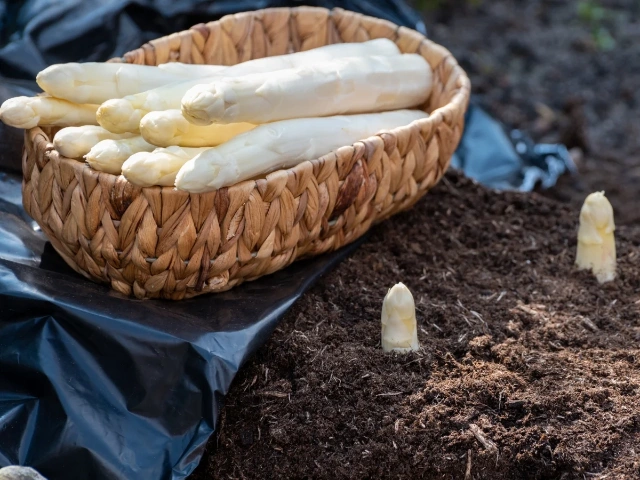
Daily monitoring is essential. Spears grow rapidly under ideal conditions (soil temperatures around 15–18°C), pushing through the soil cover. Our experienced harvest teams use long, sharp knives or semi-automated tools to cut spears at precisely 18–22 cm lengths while still underground, ensuring the tips remain tightly closed and unexposed. Harvest occurs early in the morning to minimize temperature stress and fiber development. Immediately after cutting, spears are placed tip-up in ventilated crates to avoid bruising.
Speed is critical: white asparagus is highly perishable. We transport harvests to our factory within 2–4 hours (maximum 24 hours) under refrigerated conditions (0–4°C). Upon arrival, raw material undergoes rigorous incoming inspection. We check for spear diameter (typically 8–25 mm), length uniformity, tip closure, absence of purple/green discoloration, damage, disease, or hollow cores. Only spears meeting our premium criteria proceed; substandard ones are diverted to secondary products like soups or purees.
Initial Handling and Pre-Processing
At the factory receiving dock, crates are unloaded into a pre-cooling chamber maintained at 1–2°C with high humidity (95–98%) to slow respiration and prevent dehydration or lignification (fiber toughening). This step preserves crispness and extends processing window.
Next comes thorough washing. Spears pass through multi-stage bubble washers and high-pressure spray systems using potable water to remove soil, sand, and field debris—especially from the delicate scale-like bracts at the tips. For white asparagus, we avoid overly warm water to prevent any surface staining.
Peeling follows immediately, a hallmark step unique to premium white asparagus canning. The outer fibrous layer (1–2 mm thick) must be removed to achieve the silky texture consumers expect. Our automated peeling lines—equipped with precision rotary blades and adjustable pressure rollers—gently scrape from just below the tip downward. Operators monitor and fine-tune machines for each batch's diameter and tenderness. In high-volume shifts, we combine automation with manual touch-up for spear tips to ensure flawless results. Peeled spears are instantly immersed in an acidified holding solution (citric acid or ascorbic acid at pH 4.0–4.5) to prevent enzymatic browning and oxidation.
Cutting, Grading, and Size Sorting
Peeled asparagus moves to trimming stations where ends are squared and lengths adjusted to match can specifications:
· Whole spears: 14–17 cm
· Medium cuts: 3–5 cm
· Tips & cuts: mixed small pieces
Automated cutters and vision systems ensure uniformity. Grading occurs via multi-level roller sorters and optical scanners that sort by:
· Diameter: Extra large (>18 mm), large (14–18 mm), medium (10–14 mm), small (8–10 mm), and tips
· Quality: Grade A (perfect straight spears, tight tips, no defects), Grade B (minor cosmetic issues), and processing grade
Our factory produces a range of pack styles: whole spears (often vertical-packed with tips up), cuts, tips-only, and mixed. Each grade feeds dedicated lines for optimal efficiency.
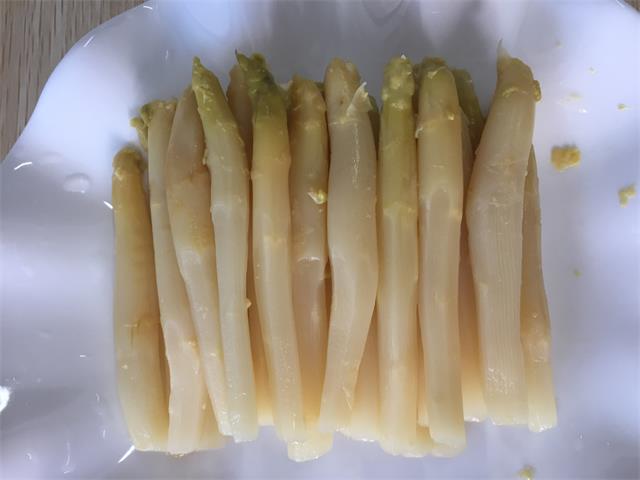
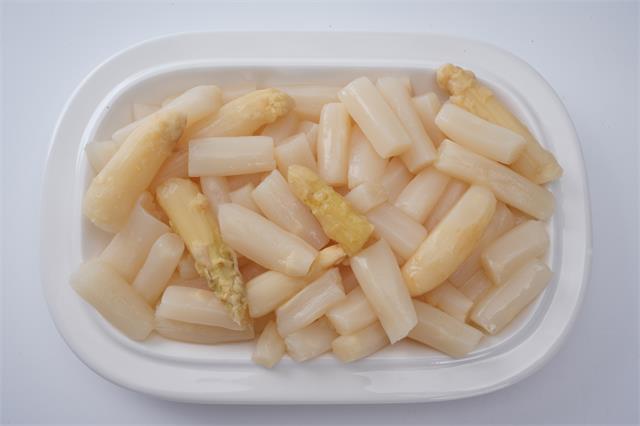
Blanching (Pre-Cooking)
Blanching is crucial for enzyme inactivation, texture softening, air expulsion, and microbial reduction. Spears enter continuous belt blanchers where they are immersed in hot water (85–98°C) for 2–6 minutes, depending on thickness:
· Small/medium: 2–4 minutes
· Large: 4–6 minutes
This brief heat treatment sets the color (maintaining pure white), reduces volume slightly for better can fill, and expels intercellular air to minimize vacuum issues later. Immediately after, spears enter ice-water shower coolers or immersion tanks (water <10°C) to halt cooking and lock in crisp-tender texture. Rapid cooling prevents over-softening and preserves the characteristic snap.
Filling, Brine Addition, and Can Seaming
Coordinated conveyor systems deliver cooled spears to filling stations. Skilled operators or robotic arms arrange spears neatly—tips aligned upward or downward per product style—in tinplate cans (common sizes: 212 ml, 370 g, 800 g, 2500 g) or glass jars. We prioritize aesthetic presentation, with uniform alignment and minimal headspace variation.
Hot brine (covering liquid) is added automatically:
· Standard recipe: Filtered water + 0.8–1.5% salt + citric acid (pH adjusted to 4.0–4.6 for optimal preservation and flavor)
· Variations may include trace sugar for balance in select markets
Precise dosing leaves 8–10 mm headspace to allow for expansion during sterilization.
Cans proceed to exhaust boxes (steam or hot-water) where internal air is expelled (center temperature reaches 75–85°C). This critical de-aeration step reduces oxygen, prevents corrosion, and ensures a strong vacuum post-cooling.
High-speed seamers then apply double-seam closures, creating hermetic seals verified by automatic seam inspection cameras.
Retort Sterilization: Ensuring Safety and Shelf Life
Filled and sealed cans enter our state-of-the-art retort systems for commercial sterilization. We use overpressure water immersion or steam-air retorts to achieve commercial sterility while preserving quality.
Typical parameters for low-acid products like asparagus:
· Temperature: 115–121°C
· Holding time: 15–40 minutes (calculated to achieve F₀ value of 6–12 or higher, depending on can size and initial load)
Overpressure prevents can distortion. Post-process, cans are rapidly cooled in circulating water to below 40°C, halting residual cooking and maintaining firmness.
Final Quality Control, Labeling, and Packaging
Cooled cans are dried, externally inspected for defects, and labeled with production codes, dates, and barcodes. We conduct incubation testing: representative samples are held at 37°C for 7–14 days to detect any thermophilic spoilage or swelling.
Only cleared batches proceed to secondary packaging—cartons, trays, or shrink-wrap—before palletizing and warehousing at ambient temperature. Shelf life under proper storage reaches 24–36 months.
Why Our White Asparagus Canned Food Stands Out
Every can from our factory embodies precision: from light-deprived field growth to gentle peeling, rapid handling, and validated thermal processing. The result is consistently tender, snow-white spears with delicate flavor—ideal for salads, gourmet dishes, or simple enjoyment straight from the can.
This demanding process—over a dozen integrated steps, countless quality checkpoints, and dedicated teams—transforms humble field spears into a premium preserved delicacy enjoyed worldwide. At our factory, we take pride in delivering not just food, but an experience of elegance and tradition in every bite.