

For most consumers, the lychee season is one of the most anticipated parts of summer. It brings a sense of abundance—bright red fruit in markets, sticky juice on hands, and the unmistakable fragrance of tropical sweetness under the heat of the sun. It feels long, relaxed, and generous.
But for those working inside the industry—growers, processors, exporters, and factory teams—the 2026 lychee season tells a very different story. It feels short. Extremely short. Almost as if it has only just begun, and is already approaching its end.
This is not an exaggeration. It is the direct result of this year’s production cycle, supply structure, and the biological reality of the lychee tree itself. The 2026 season is not only a “short season”—it is a highly compressed, high-pressure, and fast-moving cycle that has reshaped how the entire supply chain operates.
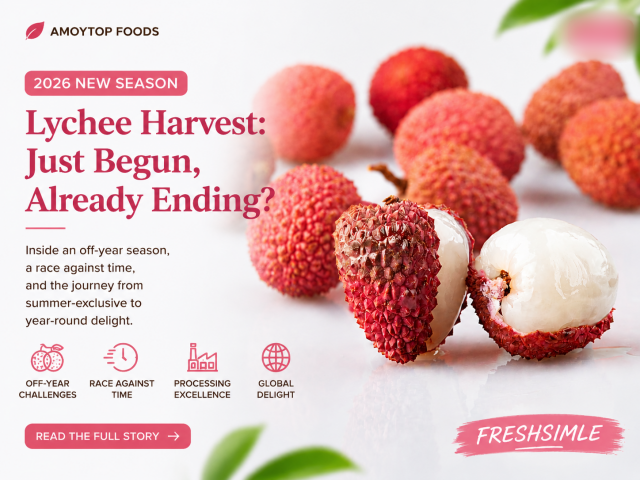
A Clearly Defined “Off-Year” That Changed the Entire Market Rhythm
The foundation of this year’s unusual situation is simple: 2026 is a typical lychee “off-year.”
According to monitoring data from the China Litchi & Longan Industry Technology System, national lychee production this year is estimated at approximately 2.31 million tons, representing a sharp 37% decline compared with 2025. In major producing regions such as Guangdong, output has fallen by nearly 40%.
This is a textbook case of “alternate bearing,” a natural biological cycle in which lychee trees alternate between high-yield “on-years” and lower-yield “off-years.” After a heavy production year, trees exhaust significant nutrients during fruiting and require time to recover. Combined with weather fluctuations during flowering and fruit-setting periods, the result is a significant reduction in yield the following year.
In 2026, this pattern has been particularly pronounced. Key commercial varieties such as Guiwei (桂味) and Nuomici (糯米糍) have experienced especially low flowering rates, estimated between 10% and 30% in many orchards. For processors, these are precisely the varieties most valued for canning due to their flavor, texture, and sweetness stability.
The impact is immediate and severe: fewer fruits, shorter harvest periods, and extreme concentration of supply within a very narrow time window.
Raw Material Competition: When Orchards Become Auction Grounds
A reduced harvest inevitably leads to one outcome: intensified competition for raw materials.
In 2026, this competition has reached an unusual level. Farm-gate prices for premium varieties such as Guiwei and Nuomici have increased by approximately 400% compared with normal years. In some regions, the situation escalated further: buyers began entering orchards as early as May, negotiating contracts even before harvest based on flowering conditions—an approach known in the industry as “pricing by blossoms.”
Some orchards were contracted at prices reaching 24,000 RMB per mu (approximately 1/15 hectare), which is 5,000–6,000 RMB higher than the previous year. Entire orchards were secured in advance, sometimes by processors or traders acting weeks before the fruit even reached maturity.
This level of pre-season contracting is not common. It reflects one clear reality: when supply tightens, control of upstream resources becomes the decisive factor in industry survival.
For processing companies, including AMOYTOP Foods, this year has effectively been a “raw material battle.” Success is no longer defined only by production capability, but also by procurement foresight, supply chain stability, and orchard-level partnerships.
A Compressed Harvest Window: Speed Becomes the Only Advantage
Beyond reduced output, the most critical challenge of 2026 is time.
Lychee is one of the most perishable fruits in the world. Its biological characteristics leave almost no room for delay. There is a well-known saying in the industry:
“One day for color change, two days for fragrance loss, three days for taste decline.”
Once harvested, lychee quality begins to deteriorate rapidly. For fresh consumption, this already presents challenges. For industrial processing, where consistency and stability are essential, the requirements are even stricter.
Fresh fruit must typically be processed within hours of harvest. If immediate processing is not possible, it must be stored at 3–5°C, and even under cold-chain conditions, the storage period should not exceed seven days.
From peeling and pitting to washing, syrup preparation, filling, sealing, sterilization, and cooling, every step must follow strict timing. Enzymatic browning, microbial growth, and oxidation processes begin immediately after harvest. Any delay directly affects final product quality—color clarity, fruit texture, syrup stability, and flavor retention.
This is why the lychee processing season is often described as a “golden window.” But in 2026, that window has become even narrower.
The 2026 Reality: A Season That “Appears and Disappears”
In typical years, the lychee processing season in Zhangzhou, Fujian—one of China’s key canned fruit production hubs—runs from late May to late June.
This year, however, the timeline has been significantly compressed:
· Hainan lychee entered the market in mid-May and ended in early June
· Guangdong Feizixiao variety peaked from mid-May to late June
As a result, the effective supply period for high-quality processing raw material has felt unusually short. It is not a gradual wave—it is more like a surge that rises quickly and disappears just as fast.
For factory operations, this creates an intense production rhythm: continuous shifts, maximized capacity utilization, and almost no buffer time between procurement and processing.
At peak season, processing lines operate around the clock. Fresh fruit arriving in the morning may already be in sterilization tanks by afternoon. Every hour matters.
In such conditions, efficiency is not just an advantage—it is survival.
Inside the Factory: A Race Against Biology and Time
Inside processing facilities such as those operated by AMOYTOP Foods, the 2026 season has been defined by urgency.
Once lychees arrive at the factory gate, they enter a tightly controlled processing chain:
1. Fresh sorting and quality inspection
2. Washing and sanitization
3. Peeling and pitting
4. Syrup preparation and filling
5. Vacuum sealing
6. High-temperature sterilization
7. Cooling and packaging
Each stage must be synchronized with precision. Any delay creates bottlenecks that can compromise entire batches.
The challenge this year is not only volume—it is concentration. With raw materials arriving in a shorter time frame, production peaks have become sharper and more intense than in previous years. Factories must scale quickly, maintain consistency, and avoid downtime.
In this sense, the 2026 lychee season is not just a production cycle—it is a logistics and timing test at industrial scale.
From Seasonal Fruit to Global Year-Round Product
Despite the pressure of a shortened harvest, the lychee industry continues to evolve in one important direction: transformation.
China, particularly Zhangzhou, known as the “Canned Food Capital of China,” plays a leading role in global canned lychee exports. Products processed during this short seasonal window are shipped through major export hubs such as Xiamen Port, reaching markets across Europe, North America, Southeast Asia, the Middle East, and beyond.
What appears to consumers as a simple canned fruit actually represents a sophisticated industrial system: one that captures seasonal freshness and extends it into year-round availability.
This transformation is critical. Fresh lychee is highly seasonal and extremely perishable. Without processing, global consumers would only enjoy it for a few weeks each year. Through canning, that short season becomes a stable, globally distributed product available at any time.
This is not just preservation—it is value extension.
The Strategic Role of Canned Lychee in Global Trade
As global demand for tropical fruits continues to grow, canned lychee has become a stable and important category in international food trade.
Its advantages are clear:
· Long shelf life without refrigeration
· Consistent sweetness and texture
· Easy storage and transport
· Year-round availability
· Stable supply regardless of climate or harvest fluctuation
For importers and distributors, this reliability is essential. It reduces risk caused by seasonal shortages, weather volatility, and agricultural uncertainty.
For producers, it creates an opportunity: to transform agricultural variability into industrial stability.
Looking Beyond 2026: Preparation for the Next Cycle
Although the 2026 processing season is nearing its end, the work does not stop here. In fact, it is only transitioning into the next phase.
For companies like AMOYTOP Foods, the post-season period is equally important. It involves:
· Evaluating raw material sourcing performance
· Reviewing production efficiency and yield rates
· Strengthening orchard partnerships
· Analyzing global market demand trends
· Planning product innovation for the next season
One key direction is product diversification. Beyond traditional syrup-packed lychees, the industry is exploring lower-sugar formulations, cleaner labels, and functional variations such as xylitol-sweetened canned lychee. These innovations align with global health trends and evolving consumer preferences.
Brand consistency also remains central. Whether under HOPELAND or FRESHSIMLE, the goal is to maintain stable quality regardless of whether the harvest year is abundant or scarce.
Conclusion: A Season That Reflects the Industry’s Reality
The 2026 lychee season is best understood not as a simple agricultural cycle, but as a snapshot of the entire industry under pressure.
It is a season defined by:
· Lower production
· Higher raw material costs
· Shorter harvesting windows
· Faster processing cycles
· Strong global demand
For consumers, it may still feel like a sweet and simple summer fruit.
For the industry, however, it is a fast-moving race that begins and ends almost before it is fully noticed.
As this season comes to a close, one thing becomes clear: the future of lychee is no longer just about harvest size. It is about efficiency, resilience, and the ability to turn a fleeting seasonal fruit into a stable global food product.
And as always, the team at AMOYTOP Foods in Xiamen stands ready for the next cycle—prepared for another season where speed, precision, and experience define success, and where every lychee tells the story of both nature and industry working under pressure.