

At Amoytop Foods, every can of asparagus undergoes strict selection, hygienic processing, and international-standard quality control to ensure freshness, safety, and consistency. This commitment transforms a seasonal delicacy into a reliable, year-round pantry staple that delivers both exceptional taste and nutritional value to consumers worldwide.
The Legacy of Amoytop Foods
Xiamen Amoytop Import & Export Co., Ltd., operating as Amoytop Foods, has built its reputation since 2009 as a professional manufacturer and exporter of processed foods. Headquartered in the vibrant coastal city of Xiamen, China, the company maintains two dedicated holding factories—one in Zhangzhou and another in Dangshan. These facilities specialize in canned vegetables and fruits sourced from the rich agricultural regions of southern and northern China.
Amoytop’s product lineup spans canned vegetables (including asparagus spears), fruits, edible fungi, and seafood, with bulk raw materials also available. The company exports to diverse markets across South America, the USA, Europe, the Middle East, Southeast Asia, and Australia, shipping hundreds of containers annually. Its management philosophy centers on honesty, credibility, cooperation, and win-win outcomes, reflected in trusted trademarks like “HOPELAND” and “FRESHSIMLE.” These brands evoke the promise of hope from the land and the joy of fresh ingredients preserved at peak quality.
Asparagus holds a special place in Amoytop’s portfolio. Known as the “queen of fine vegetables,” it offers tender stems packed with vitamins, amino acids, and minerals—often surpassing tomatoes or cabbages in certain nutrient densities. While fresh asparagus peaks between April and July, canning allows enjoyment anytime, anywhere, without sacrificing core benefits.
From Field to Factory: The Journey Begins with Selection
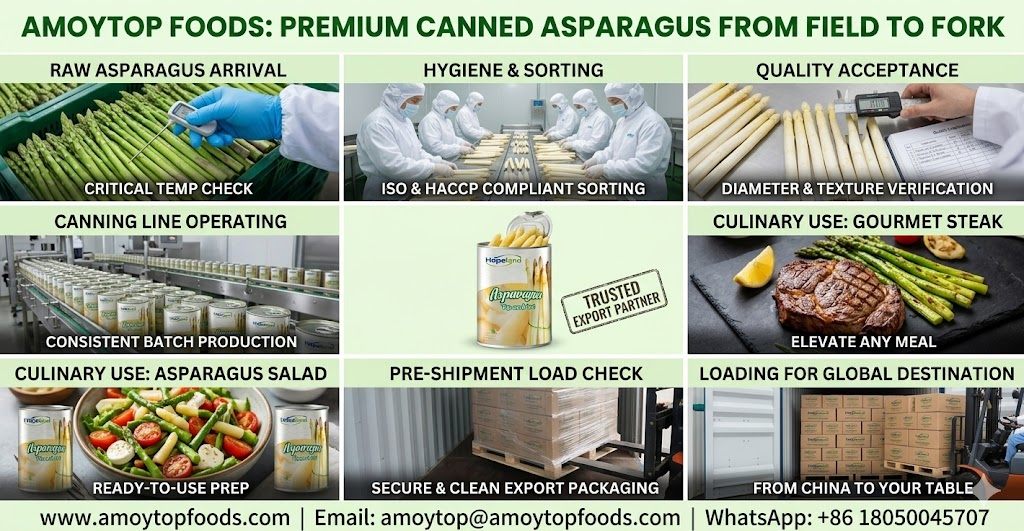
The process starts in carefully tended fields during the prime harvest window of April to June (extending into July in some regions). Farmers hand-pick spears at optimal maturity—tender, straight, and free from defects. Amoytop emphasizes rapid transport: harvests reach the factory within 2–4 hours, or at most 24 hours, under refrigerated conditions (0–4°C) to preserve freshness and minimize nutrient degradation.
Upon arrival, raw material inspection forms the first layer of strict selection. Trained quality teams examine every batch for:
· Size and uniformity (spears graded by length and diameter)
· Color and texture (vibrant green or classic white varieties)
· Absence of damage, disease, insects, or foreign matter
Only the highest-grade asparagus advances. Substandard spears are rejected immediately, ensuring consistency from the very first step. This rigorous incoming material control aligns with global best practices for processed vegetables and sets the foundation for the premium product that leaves the factory.
Hygienic Processing: Precision at Every Stage
Amoytop’s factories feature modern, sanitized production lines designed for efficiency and hygiene. The multi-step process for canned asparagus—particularly white asparagus, a popular variety—follows a carefully orchestrated sequence that locks in flavor, texture, and nutrition while eliminating safety risks.
1. Cleaning and Sorting: Asparagus undergoes thorough washing in potable water to remove soil and residues. Automated and manual sorting further refines the batch, aligning spears by size for uniform processing.
2. Peeling and Trimming (for white asparagus): The tough outer layers are peeled to reveal the tender core. Ends are precisely trimmed to standard lengths, minimizing waste while maximizing edible yield.
3. Blanching: Spears are briefly immersed in hot water or steam. This step deactivates enzymes that could cause discoloration or softening over time, softens the tissue slightly for better packing, and reduces initial microbial load. Typical parameters include temperatures around 80–95°C for short durations, tailored to variety and cut style.
4. Filling and Brining: Cleaned, blanched spears are packed into cans or jars. A brine solution (water, salt, and sometimes a touch of citric acid for pH control) fills the container, covering the product completely. Fill weights are precisely calibrated to meet drained-weight specifications and ensure consistent quality across batches.
5. Sealing and Retorting (Sterilization): Cans are hermetically sealed under vacuum or with controlled headspace. They then enter large retorts for thermal processing—high-temperature, high-pressure sterilization that destroys harmful bacteria, including Clostridium botulinum, while preserving sensory qualities. Exact time-temperature profiles are monitored continuously; typical canned vegetable retorting reaches 115–121°C for several minutes, depending on can size and product density.
6. Cooling: Post-sterilization, cans are rapidly cooled with chlorinated or treated water to prevent overcooking and “stack burn.” This step maintains the crisp-tender texture that consumers expect.
7. Drying, Inspection, and Coding: External surfaces are dried to avoid corrosion. Each can receives a thorough visual and automated inspection for dents, leaks, or seal defects. Production codes, batch numbers, and “best by” dates are laser-etched or printed for full traceability.
Throughout processing, strict hygiene protocols govern the environment. Workers follow GMP (Good Manufacturing Practices), including protective clothing, hand sanitation, and controlled access to production zones. Equipment undergoes regular cleaning and sterilization, with environmental monitoring for microbes.
International-Standard Quality Control: Safety You Can Trust
Amoytop integrates international-standard quality control at every critical point, often exceeding basic regulatory requirements. The company adheres to principles of HACCP (Hazard Analysis and Critical Control Points), identifying potential biological, chemical, and physical hazards and implementing preventive measures. Many global canned food producers, including those serving major retailers, also pursue certifications such as BRC Global Standard for Food Safety, IFS (International Featured Standards), and ISO 22000 food safety management systems. These frameworks demand documented procedures, regular audits, supplier verification, and continuous improvement.
Key quality control elements include:
· Laboratory Testing: Samples undergo chemical analysis (pH, salt content, drained weight), microbiological testing (total plate count, pathogens), and sensory evaluation (taste, color, texture). Heavy metals, pesticide residues, and additives are screened to meet stringent import limits in destination markets.
· Incubation Testing: Finished cans are held at elevated temperatures for days or weeks to detect any surviving spores that could cause spoilage. Only batches that pass are released.
· Traceability System: From farm lot numbers to final pallet labels, every can can be traced back through the supply chain. This supports rapid response in the unlikely event of an issue.
· Statistical Process Control: Automated sensors monitor critical parameters like retort temperature, fill volume, and seal integrity in real time. Deviations trigger immediate corrective actions.
· Third-Party Audits: Independent inspectors regularly verify compliance with destination-country standards (FDA, EU regulations, etc.) and voluntary grade systems such as USDA guidelines for canned asparagus, which evaluate color, defects, character, and liquor clarity on a 100-point scale.
These measures ensure not only safety but also consistency—every can delivers the same tender bite, balanced flavor, and vibrant appearance, whether it’s spears, cuts, or tips.
Nutritional Excellence Preserved
Canning, when done correctly, retains most of asparagus’s impressive nutrient profile. A typical serving (about ½ cup or 90–120g drained) provides:
· Low calories (around 20–25 kcal)
· Dietary fiber (1.8–4g) for digestive health
· High vitamin K (up to 57% DV) for bone health and blood clotting
· Significant folate (up to 34–58% DV), crucial for cell growth and especially important during pregnancy
· Vitamin C, vitamin A, and antioxidants that combat oxidative stress
· Potassium, iron, and other minerals
Studies show that while some heat-sensitive nutrients may decline slightly, fiber and many phytonutrients remain stable. Consuming the liquid in low-sodium varieties can further maximize benefits. Asparagus supports immunity, heart health, healthy blood pressure, and even potential anti-inflammatory effects thanks to compounds like saponins and phenolics. Canned asparagus offers a convenient way to incorporate these advantages into salads, soups, casseroles, stir-fries, or as a simple side dish.
Versatility in the Kitchen and on the Shelf
Amoytop’s canned asparagus shines in its versatility. Green varieties add bright color and grassy notes to pasta primavera or grilled platters. White asparagus, prized for its delicate flavor, elevates creamy risottos or elegant appetizers. Cuts and tips suit quick stir-fries or egg dishes, while whole spears make impressive standalone sides.
Because it is pre-cooked and shelf-stable for years when unopened, it reduces food waste and preparation time—ideal for busy households, food service, and emergency preparedness. Chefs and home cooks alike appreciate the consistent texture that holds up well to reheating or further cooking.
Commitment to Sustainability and the Future
Beyond quality, Amoytop recognizes the importance of responsible sourcing. By working closely with growers, the company promotes practices that maintain soil health and minimize environmental impact. Efficient factory operations reduce water and energy use where possible, and packaging innovations ( recyclable cans, optimized case packing) help lower the carbon footprint of global distribution.
Looking ahead, the company continues investing in technology—advanced sorting machines, precision retorts, and data-driven quality systems—to raise the bar even higher. As consumer demand grows for convenient, healthy, and transparently produced foods, Amoytop remains dedicated to delivering asparagus (and other specialties) that meet the highest expectations for freshness, safety, and consistency.
Conclusion: A Can Full of Promise
At Amoytop Foods, the journey of every can of asparagus exemplifies dedication to excellence. Strict selection ensures only the finest raw material enters the process. Hygienic processing transforms it with care and precision. International-standard quality control guarantees that what reaches your table is safe, consistent, and delicious—batch after batch, year after year.
Whether you’re a retailer stocking shelves, a food manufacturer developing recipes, or a family seeking nutritious convenience, Amoytop’s canned asparagus delivers on its promise. It brings the queen of vegetables to your plate with all the care of traditional craftsmanship and the reliability of modern science.
In a world where quality and trust matter more than ever, Amoytop Foods stands ready—honest, credible, and committed to putting the best of the land into every can.