

Canned yellow peaches remain one of the most stable and widely consumed fruit preserves in the global food trade. In the 2026 season, two major origins continue to shape the international supply landscape: China and Greece.
While both countries produce high-quality canned peaches, they differ significantly in production scale, raw material sourcing, processing philosophy, cost structure, and export positioning. For importers, distributors, and food brands, understanding these differences is essential for procurement strategy and market segmentation.
This article provides a deep, practical comparison of China and Greece in the 2026 canned yellow peach season, focusing on industry trends, product quality, pricing dynamics, and global demand shifts.
1. Global Overview of the 2026 Canned Yellow Peach Market
The canned yellow peach market in 2026 is shaped by three major global forces:
1. Climate variability and raw fruit instability
Unstable weather patterns in both Asia and Southern Europe have impacted fruit size, sugar content, and harvest timing.
2. Rising demand for shelf-stable fruits
Food inflation and supply chain uncertainty continue to push retail buyers toward long shelf-life fruit products.
3. Shift toward differentiated sourcing
Buyers are no longer choosing suppliers solely based on price. Instead, they prioritize consistency, traceability, and syrup customization.
In this environment, China dominates global volume supply, while Greece positions itself as a premium, origin-branded producer in European and Middle Eastern markets.
2. China’s Canned Yellow Peach Industry in 2026
2.1 Scale and Production Strength
China remains the world’s largest producer of canned yellow peaches. The industry benefits from:
· Large-scale peach orchards in Shandong, Hebei, and Henan
· Highly industrialized processing clusters
· Integrated supply chains from orchard to canning factory
· Strong export infrastructure
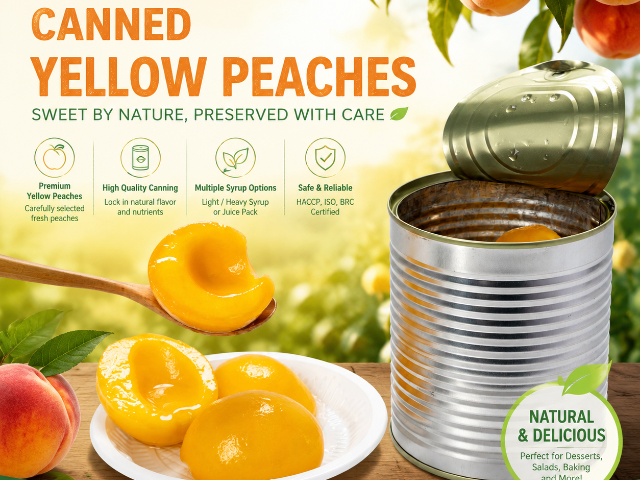
In 2026, China continues to dominate global volume exports, particularly in bulk packs such as 425g, 820g, and 3000g cans.
2.2 Raw Material Characteristics
Chinese yellow peaches used for canning typically feature:
· Medium sugar-to-acid balance
· Firm texture suitable for heat sterilization
· Varietal diversity depending on province
· High yield per hectare compared to Mediterranean regions
However, 2026 has seen moderate variability in fruit quality due to weather fluctuations, leading to:
· Slightly smaller average fruit size
· More selective grading in premium export batches
· Increased use of syrup standardization to maintain taste consistency
2.3 Processing Technology
China’s processing system is highly industrialized:
· Automated peeling and pitting lines
· High-temperature short-time sterilization
· Flexible syrup concentration (light syrup, heavy syrup, juice pack)
· Strict metal detection and export compliance systems
Many factories are also upgrading toward AI-based quality sorting systems, improving consistency across batches.
2.4 Export Positioning
China focuses on:
· Cost-competitive bulk supply
· Private label production for supermarkets
· Large-scale food service packaging
· Emerging e-commerce and B2B platforms
Its key advantage is not premium branding, but reliable volume at competitive pricing.
3. Greece’s Canned Yellow Peach Industry in 2026
3.1 Production Identity and Structure
Greece is globally known for high-quality clingstone peach cultivation, especially in Central Macedonia and surrounding agricultural zones.
Unlike China’s massive scale, Greece operates with:
· Strong cooperative farming systems
· Export-oriented processing companies
· High percentage of EU-compliant production standards
· Strong emphasis on varietal consistency
Greek canned peaches are widely recognized in European retail chains.
3.2 Raw Material Advantages
Greek peaches typically offer:
· Higher natural sweetness (due to Mediterranean climate)
· Strong aromatic profile
· Uniform fruit size in premium orchards
· Clingstone varieties ideal for halves in syrup
The 2026 harvest shows relatively stable fruit quality, though yields are slightly affected by summer heat spikes.
3.3 Processing and Quality Focus
Greek processors emphasize:
· Hand-sorted or semi-automated grading
· Lower tolerance for cosmetic defects
· EU food safety compliance (HACCP, ISO standards)
· Premium presentation for retail packaging
Compared to China, Greece produces fewer industrial bulk cans and more retail-oriented SKUs.
3.4 Export Positioning
Greece targets:
· European supermarkets
· Premium private-label brands
· Gourmet food importers
· Middle Eastern retail distributors
Greek canned peaches are generally positioned as a mid-to-premium product rather than a low-cost commodity.
4. China vs Greece: Key Differences in 2026
4.1 Production Scale
· China: Extremely large-scale, global volume leader
· Greece: Medium-scale, export-specialized production
China can stabilize global supply during shortages, while Greece cannot match volume but maintains consistency in niche markets.
4.2 Flavor Profile
· China: Balanced sweetness, adaptable to syrup formulation
· Greece: Naturally sweeter, more aromatic, fruit-forward taste
For consumers, Greek peaches often taste “closer to fresh fruit,” while Chinese peaches are more “standardized and consistent.”
4.3 Pricing Structure
· China: Lower average cost per unit
· Greece: Higher cost due to labor, EU compliance, and smaller scale
In 2026 procurement trends, China remains dominant in budget-sensitive markets, while Greece serves price-insensitive premium channels.
4.4 Packaging and Product Formats
· China: Wide variety (bulk cans, foodservice tins, OEM packaging)
· Greece: More focus on retail-ready jars and branded cans
China leads in flexibility; Greece leads in shelf presentation.
4.5 Quality Consistency
· China: High consistency in industrial grading, but varies by factory tier
· Greece: Strong consistency in premium grades, limited variability
High-end Greek products often outperform mid-tier Chinese products, but top-tier Chinese exporters can match or exceed quality expectations.
5. Market Demand Trends in 2026
5.1 Retail Market
Retail demand is shifting toward:
· Lower sugar syrup formulations
· Transparent sourcing labels
· Sustainable packaging
· “Clean label” canned fruits
Greek products benefit from strong brand perception in Europe, while Chinese products dominate private label retail globally.
5.2 Food Service and Industrial Use
China leads strongly in:
· Bakery fillings
· Yogurt fruit bases
· Large-scale catering supply
· Beverage industry use
Greece participates but at a smaller scale due to higher cost structure.
5.3 E-commerce Growth
Online grocery platforms increasingly demand:
· Mixed-size SKUs
· Fast-shipping export packaging
· Competitive pricing bundles
China has a clear advantage due to its production flexibility and logistics integration.
6. Supply Chain and Trade Dynamics
6.1 China’s Advantage: Integrated Export System
China’s supply chain strength lies in:
· High factory density
· Efficient port logistics
· Mature export documentation systems
· Scalable production capacity
This makes China a stabilizer in global supply shortages.
6.2 Greece’s Advantage: EU Trade Access
Greece benefits from:
· Duty-free access within EU markets
· Strong regulatory alignment
· Trusted origin branding
This gives Greece a strategic advantage in European retail penetration.
7. Sustainability and Industry Evolution
Both countries are adapting to sustainability pressures in 2026:
China:
· Water-efficient irrigation systems in orchards
· Reduced sugar syrup formulations
· Improved waste recycling in canning plants
Greece:
· Organic peach farming expansion
· Reduced pesticide usage
· Renewable energy integration in processing plants
Sustainability is no longer optional—it is becoming a procurement requirement in many EU and North American contracts.
8. Which Origin Should Buyers Choose?
The decision depends on market positioning:
Choose China if you need:
· Large volume supply
· Competitive pricing
· Flexible packaging options
· Private label production
Choose Greece if you need:
· Premium retail positioning
· Strong flavor profile
· EU consumer trust
· Mid-to-high-end supermarket placement
Many global importers now use a dual sourcing strategy, combining both origins:
· China for baseline supply stability
· Greece for premium segmentation
9. Conclusion
In the 2026 canned yellow peach market, both China and Greece play essential but different roles in the global supply chain.
China represents scale, efficiency, and cost competitiveness. Greece represents quality perception, flavor intensity, and premium retail branding.
Rather than direct competitors, they function as complementary pillars in the global canned fruit ecosystem. Successful importers in 2026 increasingly understand that the optimal strategy is not choosing one over the other—but leveraging both according to market demand, price sensitivity, and brand positioning.