

Introduction
Canned yellow peaches remain one of the most stable and widely traded fruit categories in the global canned food market. From retail supermarkets in Europe to food service distributors in the Middle East and bakery chains in North America, demand stays consistent all year round.
But one question keeps coming back from buyers, especially importers and private label brands:
Are Canned Yellow Peaches Halves In Light Syrup better than Canned Yellow Peaches Halves In heavy Syrup?
On the surface, it looks like a simple formulation choice—just sugar level difference. In real production and export operations, however, syrup concentration affects fruit texture stability, shipping performance, retail positioning, and even customer perception.
Here’s the thing. This is not just a product comparison. It’s actually a supply chain decision.
What Canned Yellow Peaches Really Are in Industrial Production
In factories like AMOYTOP Foods, canned yellow peaches are not “just fruit in a can.” They are a controlled food system involving:
· Raw fruit selection and firmness grading
· Peeling and halving or slicing
· Syrup formulation (light or heavy)
· Exhausting and vacuum sealing
· High-temperature sterilization
· Cooling and storage stabilization
Typical export specifications include:
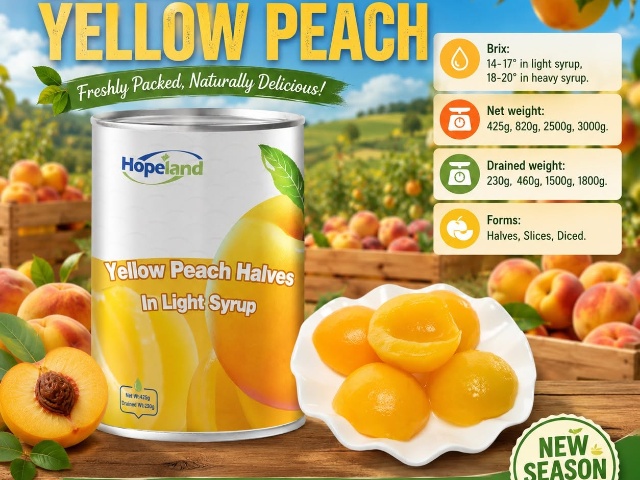
· Canned Yellow Peaches Halves In Light Syrup (Brix ~14–17%)
· Canned Yellow Peaches Halves In heavy Syrup (Brix ~18–20%+)
· Peach slice formats for bakery and industrial use
· Peach helves (a surprisingly common search typo from international buyers)
Honestly, many buyers think the product is defined at the syrup stage. In real factory logic, syrup is actually the final adjustment layer—not the core quality driver.
The core is fruit grading.
Light Syrup vs Heavy Syrup: The Real Technical Difference
Let’s be direct. The difference is not just sweetness.
It affects three major systems:
1. Flavor perception
2. Texture stability
3. Application compatibility
Light Syrup: Clean, Flexible, Retail-Friendly
Light syrup is usually designed for modern retail markets where consumers prefer less sweetness and more natural fruit taste.
Key characteristics:
· Lower sugar concentration
· Better “fruit authenticity” perception
· Easier integration into yogurt, cereal, and bakery recipes
· More aligned with EU and US supermarket labeling trends
In real export projects, we often see buyers choosing light syrup because of marketing positioning like:
“reduced sugar” or “natural taste.”
But here’s what many buyers overlook:
Light syrup exposes raw fruit quality more directly. If the peach maturity is inconsistent, defects become noticeable immediately after opening.
This is where many sourcing decisions go wrong. They optimize syrup, but ignore fruit stability.
Heavy Syrup: Stable, Rich, Dessert-Oriented
Heavy syrup is a completely different positioning.
It is widely used in:
· Dessert chains
· Buffet hotels
· Bakery filling systems
· Ice cream toppings
· Certain African and Middle Eastern retail markets
The taste is richer and more intense. From a sensory point of view, it “feels more premium” to some consumers.
However, in engineering terms, heavy syrup does something important—it buffers imperfections.
But this is also a risk.
We’ve seen real cases where:
Factories relied too much on heavy syrup to mask raw fruit inconsistency.
After 6–8 months of storage, texture collapse still appeared, especially during temperature fluctuations in shipping containers.
So heavy syrup is not a quality fix. It is a sensory adjustment layer.
Peach Halves vs Peach Slices: Why Shape Changes Everything
Another common misunderstanding is that peach halves and peach slices are interchangeable.
They are not.
Peach Halves
· Premium visual appearance
· Higher retail shelf impact
· Used in 425g and 820g cans
· Requires firmer raw fruit grading
· More sensitive to sterilization deformation
Peach Slices
· Higher packing efficiency
· Lower void space in syrup
· Better for industrial baking and mixing
· More tolerant to fruit variation
· Common in fruit cocktail systems
In real production lines, peach halves require stricter control. If the fruit is slightly overripe, it may collapse under heat sterilization pressure.
Slices, however, distribute stress more evenly.
This is why OEM buyers often switch formats depending on final application—not just customer preference.
OEM/ODM Manufacturing Reality Behind Canned Peaches
At AMOYTOP Foods and similar export factories, OEM/ODM is not just labeling.
It includes:
· Syrup Brix customization
· Fruit size grading
· Drained weight adjustment
· Packaging design (retail vs food service)
· Cut style selection (halves/slices/diced)
A very common mistake we see in B2B sourcing is this:
Buyers negotiate price per carton first, but never define drained weight properly.
In reality, drained weight determines:
· Actual fruit content per can
· Cost efficiency per serving
· Retail competitiveness
· Buyer margin stability
This is where many deals look good on paper but fail in market execution.
Why Quality Issues Often Appear After Shipping
Here’s something most non-factory buyers don’t expect:
Canned fruit problems rarely show up during sampling.
They show up after shipping.
Common issues include:
· Peach softening after long storage
· Syrup clouding under temperature changes
· Leakage due to seam pressure imbalance
· Floating fruit caused by density mismatch
Honestly, most of these are not “random failures.”
They come from:
· Incorrect sterilization curves for different can sizes
· Poor alignment between syrup density and fruit maturity
· Over-aggressive cost cutting in raw fruit selection
We’ve seen leakage issues appear only after vibration tests on long-distance sea routes. Especially routes involving high humidity + long transit time.
That’s why factory process control matters more than product appearance.
Where Buyers Usually Misjudge Product Selection
Here’s a pattern seen across many international buyers:
They compare products based on:
· Price per carton
· Can size
· Label design
But they rarely ask:
· What is your fruit firmness grading system?
· How do you control syrup migration during storage?
· What is your sterilization temperature curve?
This gap is the difference between trading mindset and manufacturing mindset.
In real projects, syrup selection is not independent. It is tied directly to fruit quality and end-use application.
Application Scenarios (Real Market Mapping)
To make this practical:
Light Syrup Peach Halves
· Supermarkets
· Health-conscious retail brands
· EU/US private labels
· Yogurt and cereal applications
Heavy Syrup Peach Halves
· Dessert chains
· Buffet hotels
· Middle East retail
· Ice cream topping systems
Peach Slices
· Bakeries
· Industrial food processing
· Fruit cocktail manufacturers
So the real question is not “which is better,” but:
Which application are you targeting?
FAQ (Frequently Asked Questions)
1. Are light syrup peaches healthier than heavy syrup peaches?
Yes, light syrup generally contains less sugar, making it more suitable for health-positioned retail products.
2. Do heavy syrup peaches taste better?
They taste sweeter and richer, but “better” depends on consumer preference and application.
3. What is the difference between peach halves and peach slices?
Halves are visually premium and used in retail cans; slices are better for baking and industrial processing.
4. What does “peach helves” mean?
It is a common spelling error for “peach halves,” frequently seen in global search queries.
5. What is the shelf life of canned yellow peaches?
Typically 24–36 months depending on sterilization and storage conditions.
6. Can syrup sweetness be customized in OEM production?
Yes, factories can adjust Brix levels according to market requirements.
7. Why do peaches sometimes become soft after shipping?
Usually due to fruit maturity inconsistency or insufficient sterilization control during production.
8. Which markets prefer heavy syrup peaches?
Middle East, parts of Africa, and dessert-oriented food service industries.
Conclusion
So, are Canned Yellow Peaches Halves In Light Syrup better than Canned Yellow Peaches Halves In heavy Syrup?
The honest answer is: it depends on how the product is used, not just how it tastes.
Light syrup is more aligned with modern retail, health positioning, and flexible food applications. Heavy syrup still dominates traditional dessert and food service markets where sweetness and sensory richness matter more.
In real manufacturing and export business, the winning strategy is not choosing one over the other—but matching syrup type, fruit grade, and cut style to the exact end-use scenario.
That is where product performance becomes predictable, and where supply chain problems usually disappear.